A Numerical Analysis of NACA 0015 Airfoil with Different Types of Flaps
DOI:
https://doi.org/10.38032/jea.2025.03.001Keywords:
NACA 0015 Airfoil, Lift, Drag, Flap, ANSYS, Static pressureAbstract
Enhancing aerodynamic performance is critical in the aviation industry to improve aircraft efficiency and reduce fuel consumption. Airfoils, which generate lift and drag during motion through a fluid, are highly sensitive to geometric modifications. This study investigates the aerodynamic behavior of a NACA 0015 airfoil equipped with various flap configurations and flap deflection angles. Flaps are widely used to increase the camber and effective angle of attack of an airfoil, thereby enhancing lift generation. The NACA 0015 airfoil was modeled using SOLIDWORKS, and computational fluid dynamics (CFD) simulations were performed in ANSYS Fluent, employing the k-ω SST turbulence model at a Reynolds number of 100,000. Results indicate that both lift and drag coefficients increase with the angle of attack. The highest lift coefficient was achieved using a plain flap at a deflection angle of 20° and an angle of attack of 10°, while the highest drag force occurred under the same conditions. Compared to the baseline (unmodified) airfoil, the lift-to-drag ratio improved significantly with flap deployment, reaching its maximum for a plain flap at a 10° deflection. The simulation outcomes were validated against available experimental data under comparable boundary conditions. These findings offer valuable guidance for optimizing airfoil-flap configurations, with direct implications for the design of more efficient wing and control surface systems in modern aircraft, ultimately contributing to enhanced fuel economy and overall aerodynamic performance.
References
[1] “Airfoil - Wikipedia.” https://en.wikipedia.org/wiki/Airfoil (accessed Aug. 21, 2022).
[2] “Factors that Affect Lift.” https://www.grc.nasa.gov/WWW/k-12/airplane/factors.html (accessed Aug. 21, 2022).
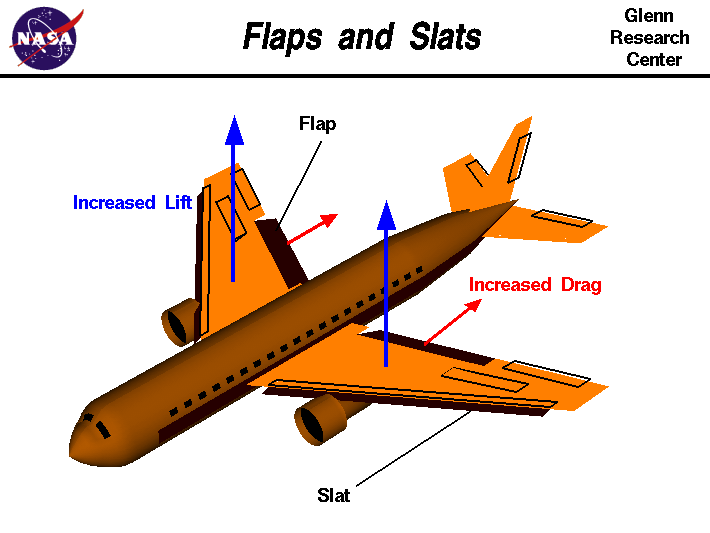
[3] “flap.gif (710×533).” https://www.grc.nasa.gov/www/k-12/airplane/Images/flap.gif (accessed Aug. 21, 2022).
[4] Hasan, S.M., Islam, S.M. and Haque, M., 2021. Comparison of aerodynamic characteristics of NACA 0012 and NACA 2412 airfoil. IJRASET, 9, pp.2037-2045. DOI: https://doi.org/10.22214/ijraset.2021.36766
[5] Sharma, D.M. and Poddar, K., 2010, October. Experimental investigations of laminar separation bubble for a flow past an airfoil. In Turbo Expo: Power for Land, Sea, and Air (Vol. 44014, pp. 1167-1173). DOI: https://doi.org/10.1115/GT2010-22224
[6] Tremblay-Dionne, V. and Lee, T., 2019. Effect of trailing-edge flap deflection on a symmetric airfoil over a wavy ground. Journal of Fluids Engineering, 141(6), p.064501. DOI: https://doi.org/10.1115/1.4041736
[7] Izzet ş., ACIR, A., 2015. Numerical and Experimental Investigations of Lift and Drag Performances of NACA 0015 Wind Turbine Airfoil. International Journal of Materials, Mechanics and Manufacturing, 3(1). DOI: https://doi.org/10.7763/IJMMM.2015.V3.159
[8] Rubel, R.I., Uddin, M.K., Islam, M.Z. and Rokunuzzaman, M.D., 2016. Numerical and experimental investigation of aerodynamics characteristics of NACA 0015 airfoil. International Journal of Engineering Technologies IJET, 2(4), pp.132-141. DOI: https://doi.org/10.19072/ijet.280499
[9] Ahmed, T., Amin, M.T., Islam, S.R. and Ahmed, S., 2014. Computational study of flow around a NACA 0012 wing flapped at different flap angles with varying Mach numbers. Glob J Res Eng, 13(4), pp.4-16.
[10] Daud, N.M., Sudin, M.N. and Zakaria, M.S., 2022. Flow analysis of airfoil with mechanical slat and flap using CFD. Journal of Engineering and Technology (JET), 13(1), pp.73-82.
[11] Wilcox, D.C., 1988. Reassessment of the scale-determining equation for advanced turbulence models. AIAA journal, 26(11), pp.1299-1310. DOI: https://doi.org/10.2514/3.10041
[12] Menter, F.R., 1994. Two-equation eddy-viscosity turbulence models for engineering applications. AIAA journal, 32(8), pp.1598-1605. DOI: https://doi.org/10.2514/3.12149
[13] Aftab, S.M.A., Mohd Rafie, A.S., Razak, N.A. and Ahmad, K.A., 2016. Turbulence model selection for low Reynolds number flows. PLOS one, 11(4), p.e0153755. DOI: https://doi.org/10.1371/journal.pone.0153755
[14] De Simone, N., Cenedese, D., Aniello, A., De Simone, F. P. and De Simone, N., 2020. Wind Tunnel Testing of NACA 0015 and NACA 23012 Airfoils, Politecnico di Milano.
Downloads
Published
Data Availability Statement
Data will be made available on request.
Issue
Section
License
Copyright (c) 2025 Simanto Das, Md. Atikur Rahman Khan, Sudipto Kumar Dash, Eyasin Hossain Sayeed, Md. Mehdi Masud Talukder

This work is licensed under a Creative Commons Attribution-NonCommercial 4.0 International License.
All the articles published by this journal are licensed under a Creative Commons Attribution-NonCommercial 4.0 International License